Book Review of Border Town
Everything happens by chance, yet the outcome seems as inevitable as fate.
Table of Contents
Amid the gentle breeze of Chatong lies the purest form of waiting.
“By winter, the crumbling white pagoda had been rebuilt. The young man who sang under the moonlight—whose voice caused Cui Cui’s soul to float gently in her sleep—had not yet returned to Chatong. … Perhaps he would never return; perhaps he would return ‘tomorrow’!”
Shen Congwen uses this open-ended conclusion to bring Border Town to a close. When will the young man singing love songs finally return? The book leaves this unstated, yet it leaves the reader with boundless wistfulness and anticipation, allowing their thoughts to drift among the mountains and streams of Chadong. Just like the mountain songs that drift across the Chatong Stream—their melodies simple and unadorned, yet capable of creating ripples that spread layer upon layer in the listener’s heart, lingering long after they’ve faded.
What kind of love is worth waiting a lifetime for? Perhaps we, as readers, may not yet fully grasp it, but Shen Congwen understood, and Cui Cui understood as well. At the age of fourteen or fifteen, when one’s heart is brimming with dreams of love, Cui Cui sought neither wealth nor prestige, but simply that the man she loved would sing love songs to her for three years and six months—so that she might drift off to sleep to the melody and wander through her dreams. In the book, after listening to Erlao’s singing, she describes her dream as follows: “ ‘Just yesterday in my dream, I heard the most beautiful singing—so soft and lingering. It was as if I were following that voice, flying everywhere, all the way to the middle of a cliff by the stream, where I picked a big bunch of saxifrage. Once I had the saxifrage, I didn’t know who to give it to. I slept so well, and my dream was so wonderful!’”
With just a few words, he brings to life a vivid and three-dimensional portrait of a young girl immersed in romantic fantasies. We may not be able to make out her features clearly, but we can certainly imagine her clear, luminous eyes and her crystal-clear heart. Emotions in the city are often turbulent and complex, much like river water mixed with silt, sand, and rocks; yet the feelings in Border Town are as simple as love or no love—there is no need for circumlocution or testing; a single sentence is enough to make it clear.
Da Lao, having developed feelings for Cui Cui, bluntly expressed his intentions to her grandfather: “Uncle, your Cui Cui is truly lovely—she looks just like the Goddess of Mercy.” In another two years, if I have the time to stay in Chatong and tend to my affairs—instead of flitting about like an old crow all day—I’ll definitely come down to this stream every night to sing for Cui Cui.” ”Later, due to his busy schedule, he chose to take the “formal route” and sent a matchmaker to propose marriage. Cui Cui’s feelings, too, were revealed in subtle ways: “Cui Cui realized that it was the Elder who had sent the matchmaker! She didn’t lift her head; her heart was pounding, her face burning fiercely, yet she continued shelling her peas, casually tossing the empty pods into the water. Watching them drift leisurely downstream, she herself seemed to grow much more composed.” This “composure” was, in fact, the best proof of her indifference toward the Elder.
The Second Old Man was different. On the night of the Dragon Boat Festival, after Cui Cui had waited a long time for her grandfather, who had not arrived, she happened to encounter the Second Old Man returning from catching ducks. Just a few brief exchanges left a deep impression on Cui Cui’s heart; whenever she recalled them, she would suddenly fall silent. This quietly blossoming sentiment must have been the first stirrings of love. What was even more remarkable was that, upon learning her brother also harbored feelings for Cui Cui, the Second Old Man still bravely confessed his heart. He understood Cui Cui’s feelings better than anyone and chose to walk along “the road” to sing love songs for her for three years and six months. And his singing truly found its way into Cui Cui’s dreams, allowing her to feel that sweetness even in her sleep. The harmony between their two hearts required no many words—it was crystal clear—and once it took root, it became unshakable.
This persistence in love is precisely like that of Cui Cui’s parents. Back then, Cui Cui’s mother fell in love with a soldier, but because society would not tolerate it, she found herself in a desperate situation. The soldier took his own life by poisoning himself, hoping only to be with his beloved in death; Cui Cui’s mother, however, clung to life for the sake of the child she carried, and after the child was born, she followed her lover without hesitation. Such profound devotion, defended with one’s very life, should have been earth-shattering; yet Shen Congwen glosses over it with just a few understated strokes, as if recounting an ordinary tale from the past. Yet beneath the calm prose lies a surging emotional force powerful enough to shake the soul of every reader.
After the Elder’s unexpected passing, the Second Elder’s heart was filled with resentment toward his grandfather, yet he could not bring himself to let go of his love for Cui Cui; he still expressed to others his desire for a ferry rather than a mill. These complex emotions led him to choose to leave his hometown. As for Cui Cui, after her grandfather’s death, she learned of the Second Elder’s true feelings from others and came to understand the many entanglements of the past that she had previously failed to grasp. From then on, she settled into a life of quiet anticipation, waiting day after day by the stream—with no promises and no set date for his return, yet always holding onto the hope that “he’ll be back tomorrow” as she waited patiently.
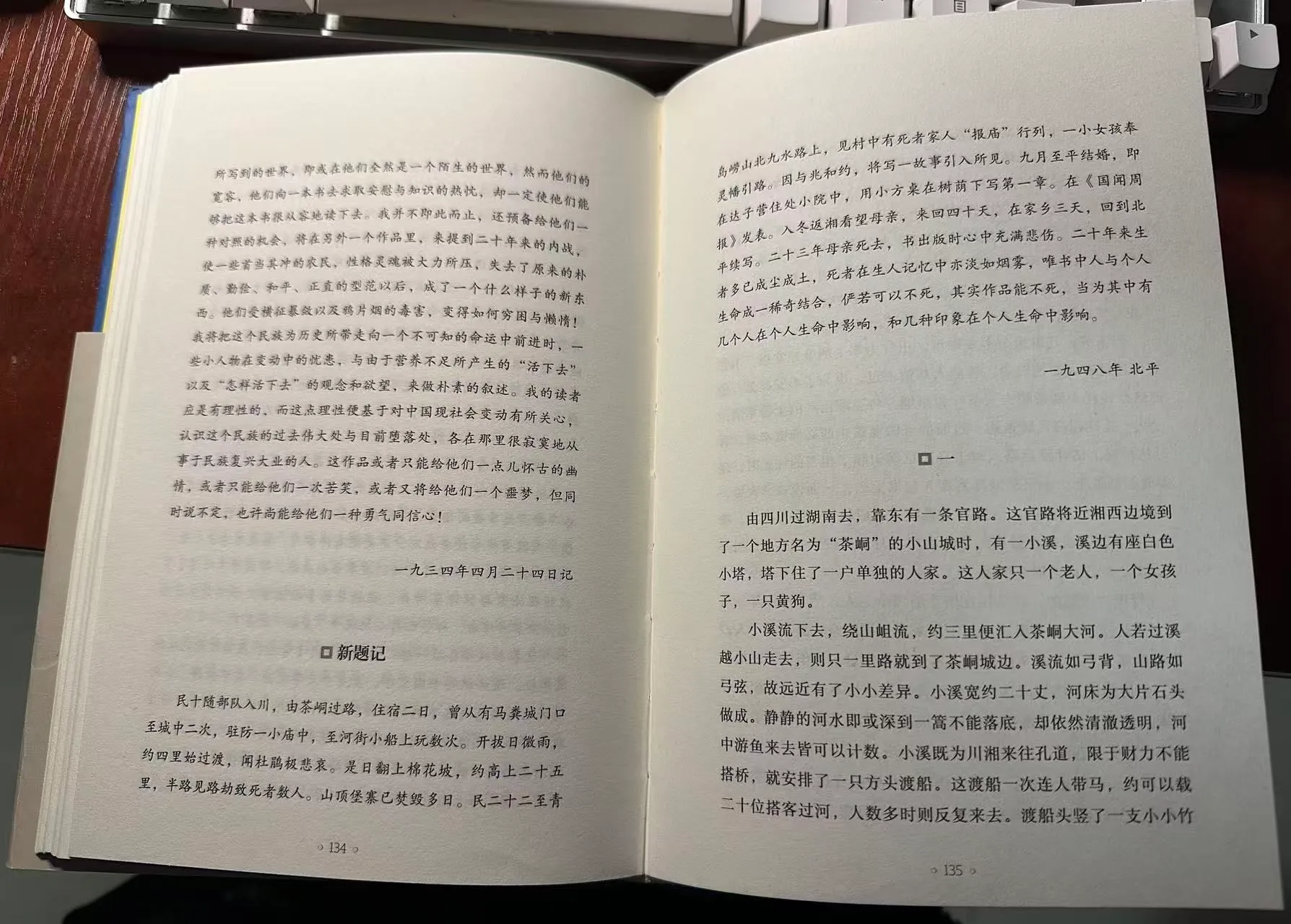
Border Town is like a gentle breeze, caressing our restless hearts. Simplicity is never synonymous with dullness; on the contrary, it is precisely this simple prose and straightforward plot that harbor the most intense and sincere emotions. The prose of Border Town, much like the folkways of Chatong, is simple, pure, and open-hearted; it reveals greatness in the ordinary and depth in the mundane—this is Shen Congwen’s unique literary style.